Practical
Is Niagara Falls Worth Visiting? An Honest Look Before You Go
Yes, for most people Niagara Falls is worth visiting, and the reason is simple: there are few places on earth where you can get this close to this much moving water. More than 6 million cubic feet of it go over the crest every minute at peak daytime flow, according to Niagara Parks, and you can stand at the brink, ride a boat into the spray at the bottom, walk on decks beside the falling water and look out from tunnels behind it, all in one day.
It is not a wilderness, though, and that is the main reason some visitors come away disappointed. The falls sit between two cities, the parks on each bank are busy in summer, and the streets beyond them are full of hotels and attractions. If you go knowing what to expect, picking the right season and the right side, Niagara rarely lets people down. This article sets out the case for and against, so you can decide.
The short answer
Niagara Falls is worth visiting if:
- You want to feel the power of a waterfall up close. Few big waterfalls let you get this close, this easily, from both above and below.
- You can spend at least a full day. Niagara Falls State Park says that to see everything in the park you should plan to stay at least a day, and that is one side of the river only.
- You can visit between late spring and fall, when the boats sail and the falls run at full daytime flow.
It may disappoint if you expect remote scenery, if you can only spare an hour or two at a crowded overlook on a summer weekend, or if your idea of a waterfall is a very tall one.
What makes Niagara special: volume, not height
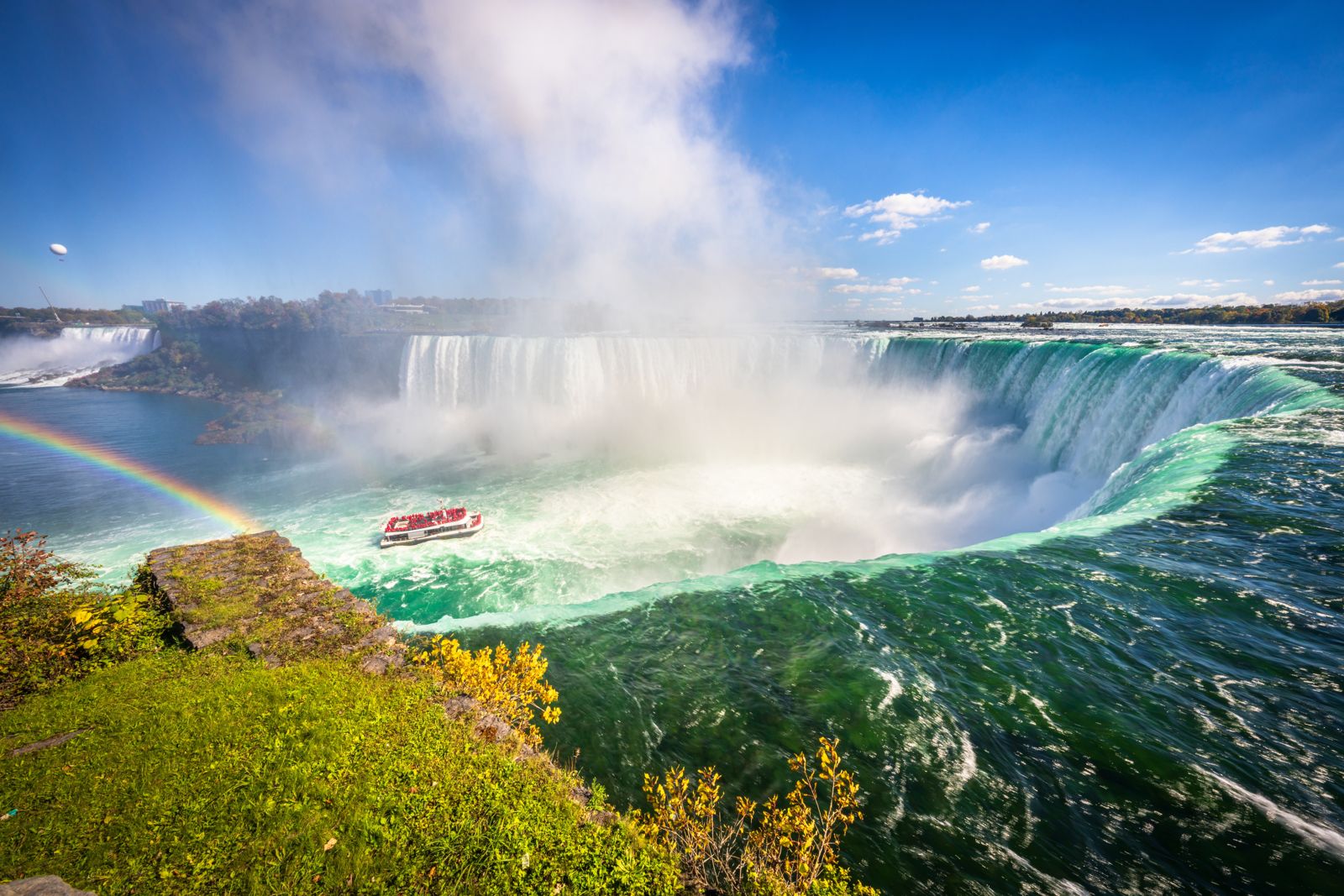
Niagara is not the world’s tallest waterfall. Niagara Parks says there are about 500 taller ones; what makes Niagara impressive is the combination of height and volume. The Horseshoe Falls, the largest of the three falls, drops an average of 188 feet, and its crest line is about 2,200 feet wide. The American Falls is 70 to 110 feet high measured to the rock pile at its base, with a crest about 850 feet wide. The small Bridal Veil Falls sits beside it, separated by Luna Island.
The water comes from four of the five Great Lakes, Erie, Huron, Michigan and Superior, and funnels through the Niagara River on its way to Lake Ontario. The figures vary with how they are measured. Maid of the Mist gives about 600,000 gallons a second; Niagara Parks says more than 6 million cubic feet a minute at peak daytime flow. Either way, the result is a roar you feel through your feet, a constant cloud of spray, and a river so deep below the falls that Maid of the Mist gives the average depth as 170 feet, as deep as the gorge is high.
Two more details people remember. The water is a startling green, which Niagara Parks attributes to dissolved salts and finely ground rock; an estimated 60 tons of dissolved minerals go over the falls every minute. And the brown foam below the falls, which can look like pollution, is natural: clay with particles of decayed plants, mostly from Lake Erie.
How close you can get
What sets Niagara apart from most great waterfalls is access. In a single day you can:
- Stand at the brink. Terrapin Point on Goat Island sits above the Horseshoe Falls, and Table Rock on the Canadian side is at its edge.
- Sail into the spray. The Maid of the Mist from New York, and Niagara City Cruises from Ontario, take you past the American and Bridal Veil Falls into the basin of the Horseshoe Falls.
- Walk to the foot of a waterfall. Cave of the Winds takes you down to wooden decks at the base of the Bridal Veil Falls.
- Look out from behind it. Journey Behind the Falls, on the Canadian side, descends 125 feet to tunnels and portals behind the Horseshoe Falls.
- Fly over it. Helicopter flights leave from both sides.
Few visitors forget the moment the boat turns into the horseshoe and the falls close in on three sides. Our guide to Niagara Falls boat tours compares the ways onto the water.
What it costs, and what is free
Seeing the falls costs nothing. Niagara Falls State Park on the New York side is open 365 days a year, 24 hours a day, and it is always free to walk in. Prospect Point, Goat Island, Luna Island and the Three Sisters Islands are all free, as are the nightly illumination and, from May to October, the fireworks. The promenade along the Canadian bank is free too.
You pay for parking and for the experiences that get you closer. A few 2026 examples:
- Maid of the Mist: $30.25 for an adult, $19.75 for a child aged 6 to 12.
- Cave of the Winds: $14 for adults and $10 for youth from October 19, 2026 to March 31, 2027, more in summer.
- Journey Behind the Falls: $33 for adults on Niagara Parks’ list, in Canadian dollars.
- Parking at Prospect Point: $10 a day, or $15 from Friday to Sunday in summer.
Niagara Parks prices are in Canadian dollars; it accepts US dollars at its own exchange rate, which it gives as $1 USD to $1.30 CAD. Our guide to Niagara Falls tickets and prices lists everything.
A place with a history worth knowing
Part of what makes Niagara worth the trip is that its story is written into the landscape. The falls formed at the end of the last Ice Age: the Niagara Peninsula became free of ice about 12,500 years ago, and some 12,000 years ago water began plunging over the Niagara Escarpment. Native Americans living in the region were, the state park notes, most likely the first people to see the falls. The first European to document them was the French priest Louis Hennepin, on a 1678 expedition; his book brought Niagara to the attention of the western world.
Tourism followed. In 1804 Jerome Bonaparte, Napoleon’s younger brother, honeymooned at the falls with his American bride, by local lore starting Niagara’s honeymoon tradition, and railroads in the 1800s brought crowds. So did industry. In the early 19th century mills and factories spread along the river, and by the late 1860s a group including the landscape architect Frederick Law Olmsted had founded the Free Niagara movement to win the land back for the public. After more than 15 years of pressure, New York created the Niagara Reservation in 1885. The park calls itself America’s oldest state park, and Olmsted’s network of footpaths through the woods and along the river is still the way you walk it today.
Niagara also helped power the modern world. The world’s first large-scale hydroelectric station opened at the falls in 1895, and in 1896 Nikola Tesla’s alternating-current system sent electricity from Niagara Falls to Buffalo, the first long-distance commercial use of AC. Today the plants on both banks can produce up to 2.4 million kilowatts. You can see the ruins of the Schoellkopf Power Station, which collapsed in 1956, from a free elevator into the gorge, and on the Canadian side a 115-year-old power station is now an attraction with a tunnel to the river.
A waterfall that moves
There is a geology lesson here too. Niagara Falls has moved back seven miles in 12,500 years, carving the gorge as it went. Niagara Parks says the falls now erode about 1 foot a year, much less than in the past because so much water is diverted, and that perhaps 2,000 years from now the American Falls could dry up. Along White Water Walk in the gorge, the cliffs show rock layers about 410 million years old. For anyone with an interest in how landscapes are made, it is a striking place to stand.
The honest downsides
Niagara has its critics, and they are not wrong about everything.
- It is busy. In summer, especially on weekends, the viewpoints and boat lines are crowded. Niagara Falls State Park warns that its lots fill early on weekends, including Fridays, and on holidays.
- It is built up. The parks on both banks are protected, but the cities around them are full of hotels, casinos and paid attractions. If you want only nature, stay inside the parks.
- The falls are partly controlled. A treaty lets much of the river be diverted to power plants. The 1950 Niagara Treaty keeps at least 100,000 cubic feet per second over the falls in daylight hours of the tourist season, from April 1 to October 31, and half that at night and in winter.
- Winter changes the trip. The Maid of the Mist does not sail in winter; in 2026 its season ended on November 8. Several Canadian attractions, among them White Water Walk and the Whirlpool Aero Car, close from late fall to spring.
- You will get wet. On the boats and decks, the ponchos help but do not keep you dry.
None of these is a reason to skip Niagara, but each is a reason to plan.
New York side or Canadian side?
Both sides are worth seeing, and each does something better.
- The New York side puts you beside the falls. Goat Island and the islands in the rapids let you stand at the brink of both the American and Horseshoe Falls, the Observation Tower gives a panoramic view of all three falls, and Cave of the Winds and the Maid of the Mist start here. You do not need a passport.
- The Canadian side gives the view across. From the promenade you see the American Falls side-on and look straight into the curve of the Horseshoe Falls, and the Canadian attractions go deep into the gorge.
If you can, cross the Rainbow Bridge; pedestrians can walk it. Niagara Parks says U.S. citizens need a valid passport to enter Canada, and Niagara Falls State Park reminds American visitors that they must show one at the border. Our getting there guide covers the crossing.
How long do you need?
A quick look takes an hour: walk out to Prospect Point and Terrapin Point and you will have seen the falls. But that is the trip most likely to disappoint. A full day on one side lets you do a boat, one walk to the base and the main viewpoints, and stay for the lights. Two days, one per side, is the comfortable way to see both, with time for the gorge trails or the Whirlpool Aero Car.
If you are coming from far away, it helps to know the distances. Buffalo Niagara International Airport is about 30 miles from the state park. Day trips by tour from New York City and Toronto are popular; they are long days, but for travelers without a car they take care of the driving and the timing. The tours page lists them.
Who will love Niagara Falls
- First-time visitors to North America, for whom Niagara is often a bucket-list sight.
- Families, because the boats, the decks and the illumination work for children, and much of the New York park is accessible: the park says all its attractions and most trails can be used with a wheelchair.
- Photographers, for the rainbows in the spray, the night lighting and, in winter, the ice.
- History and engineering fans, for the Free Niagara story, Tesla and the power plants.
- Walkers, who can leave the crowds behind on the gorge trails; the park has over five miles of them.
Who might not: travelers who only want wild, remote scenery, and anyone who can only come for a short stop on a crowded summer weekend.
How to make the most of it
- Go between late spring and fall if you want the boats; go in winter for the ice and quiet.
- Arrive early, before the lots fill and the boat lines build.
- Visit midweek if you can. Lot 3 on Goat Island is free on Tuesdays, Wednesdays and Thursdays.
- Do one thing that gets you close. A boat, Cave of the Winds or Journey Behind the Falls is what turns a nice view into a memory.
- Stay after dark. The falls are lit every night of the year, and from May to October there are fireworks at 10 p.m.
- Bring a passport so you can see both sides.
The verdict
Niagara Falls is worth visiting for the same reason it has drawn visitors for more than two centuries: the sheer force of the water, and how close you can get to it. The parks around it were protected precisely so that anyone could walk to the brink for free, and they still can. Go with a full day, pick your season, do at least one thing that takes you to the foot of the falls, and the crowds and the neon fade into the background. For guided ways to see it, from a walking tour with the boat to day trips from New York City and Toronto, see the tours page.
Frequently asked questions
Is Niagara Falls worth visiting in winter?
Yes, if you want ice and fewer people rather than boat rides. The Maid of the Mist does not sail in winter, but Cave of the Winds and Journey Behind the Falls are open all year, the falls are lit every night, and the frozen spray makes a striking scene.
Is Niagara Falls worth it without going to Canada?
Yes. The New York side has the best places to stand beside the falls, Cave of the Winds, the Maid of the Mist and the Observation Tower’s view of all three falls, with no passport needed. The Canadian side adds the head-on view of the Horseshoe Falls.
Is it worth paying for the Maid of the Mist?
For most visitors, yes; it is the classic Niagara experience. In 2026 an adult ticket cost $30.25 for a 20-minute ride into the basin of the Horseshoe Falls, poncho included.
How much time do you need at Niagara Falls?
At least a full day for one side, which is what Niagara Falls State Park recommends for the park alone. Two days lets you see both sides without rushing.
Is Niagara Falls the tallest waterfall in the world?
No. Niagara Parks says there are about 500 taller waterfalls. Niagara’s fame comes from its volume combined with its height.